Variant Genes — Which Genes Carry Damaging Variants?
In the app: Variants › Variant Genes
Available on projects with variant (SNP) data whose variants are annotated with genes — variant_genes.tsv, or a variants.tsv with gene and impact columns.
Variant Genes turns the variant list into a gene list: for each gene, how many of its variants the annotator rated HIGH, MODERATE, LOW or MODIFIER impact, and which samples carry the HIGH-impact ones. It answers "which genes are hit by likely damaging variants, and in how many samples?" On a project that also has differential expression, it shows which of those genes are differentially expressed and links each to Gene Card.
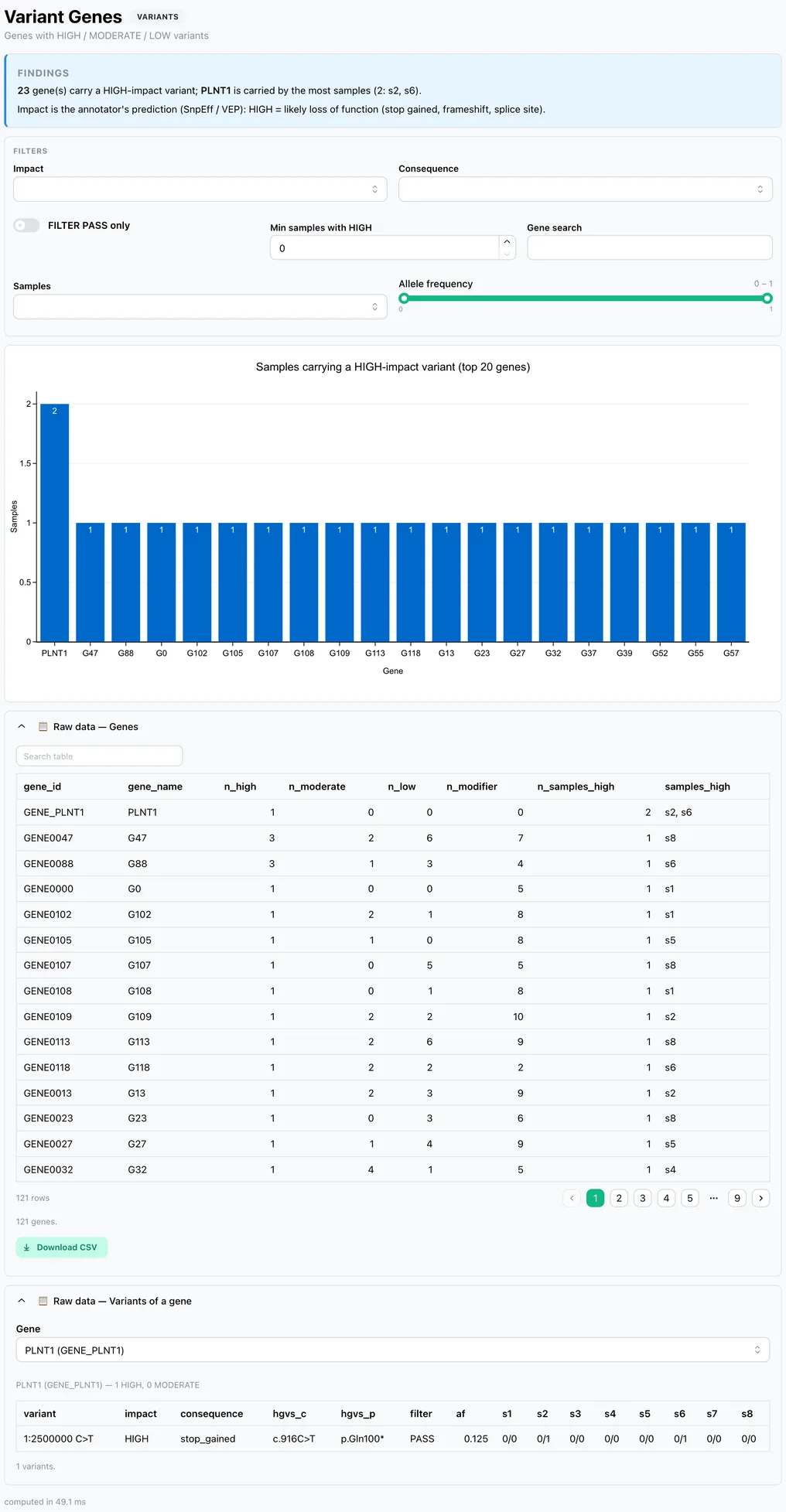
Example output from a demonstration project with synthetic data.
Findings
How many genes carry a HIGH-impact variant, and which gene is carried by the most samples (with the samples named). A reminder follows: "Impact is the annotator's prediction (SnpEff / VEP): HIGH = likely loss of function (stop gained, frameshift, splice site)."
Notes appear when the per-sample genotypes were read from variants.vcf.gz instead of variants.tsv, or when no per-sample genotypes are available at all — then carriers come from the pipeline's variant_genes.tsv and the Samples filter does not apply. If only variant_genes.tsv exists, the table is shown as delivered, without filters.
Filters
Impact
Keep only variants of the chosen impact classes: HIGH, MODERATE, LOW, MODIFIER. Empty means all.
Consequence
Keep only variants with the chosen consequence terms (for example missense_variant, stop_gained, frameshift_variant). The list holds the terms present in the project. Empty means all.
FILTER PASS only
Off by default. On, only variants that passed the caller's filters are counted.
Min samples with HIGH
Keep only genes where at least this many samples carry a HIGH-impact variant. Default 0 (no limit); the maximum is the number of samples.
Gene search
Find a gene by name or ID.
Samples
Count only the chosen samples as carriers. Empty means all samples.
Allele frequency
A range slider from 0 to 1 (default the full range) to keep variants within an allele-frequency band — for example only rare or only common variants. Shown when the variants carry an allele frequency.
Samples carrying a HIGH-impact variant (top 20 genes)
A bar chart of the top 20 genes by the number of samples carrying a HIGH-impact variant in them, with the count on each bar.
Raw data
Raw data — Genes
One row per gene, after the filters. Searchable, with Download CSV.
| Column | Meaning |
|---|---|
gene_id, gene_name |
The gene |
DE in any contrast |
Whether the gene is differentially expressed in any contrast (projects with DE results only) |
n_high, n_moderate, n_low, n_modifier |
Number of the gene's variants in each impact class |
n_samples_high |
Number of samples carrying a HIGH-impact variant in the gene |
samples_high |
Those samples |
Raw data — Variants of a gene
Choose a gene with Gene to list its variants. A caption gives the gene's HIGH and MODERATE counts.
| Column | Meaning |
|---|---|
variant |
Position and change, for example 1:2500000 C>T |
impact, consequence |
The annotator's impact class and consequence term |
hgvs_c, hgvs_p |
The change in HGVS notation, at cDNA and protein level |
filter |
FILTER value |
af |
Allele frequency |
| one column per sample | The sample's genotype, for example 0/0, 0/1, 1/1 |
On a project with DE results, View gene in Gene Card opens the chosen gene in Gene Card.
Report settings that apply
None of the filter settings in the Report settings panel change this report. Appearance sets the plot styling (see Report Settings).
Reading it
- Impact classes are predictions from the variant's position and the gene model, not measured effects. A HIGH-impact variant in a gene with many paralogs, or in a rarely used transcript, may be harmless.
- Genotypes read
0/0(reference),0/1(heterozygous) and1/1(homozygous alternate);./.means no call. - A gene carried by several samples of one group and none of another is a candidate for Association, when association was run.