Copy Number / Karyotype — Gains, Losses and Structural Variants
In the app: Copy number & structural › Copy Number / Karyotype
Available on projects with copy-number (CNV) or structural-variant (SV) analysis — chromosome projects — once the pipeline has delivered cnv_segments.tsv, sv.tsv or chromosome_summary.tsv.
Copy Number / Karyotype answers "has any sample gained or lost a whole chromosome or part of one, and what structural rearrangements were called?" It draws a karyotype grid of every sample and chromosome, the genome-wide copy-number profile of one sample, a cohort matrix of copy number, and the list of structural variants — deletions, duplications, inversions, insertions and translocations.
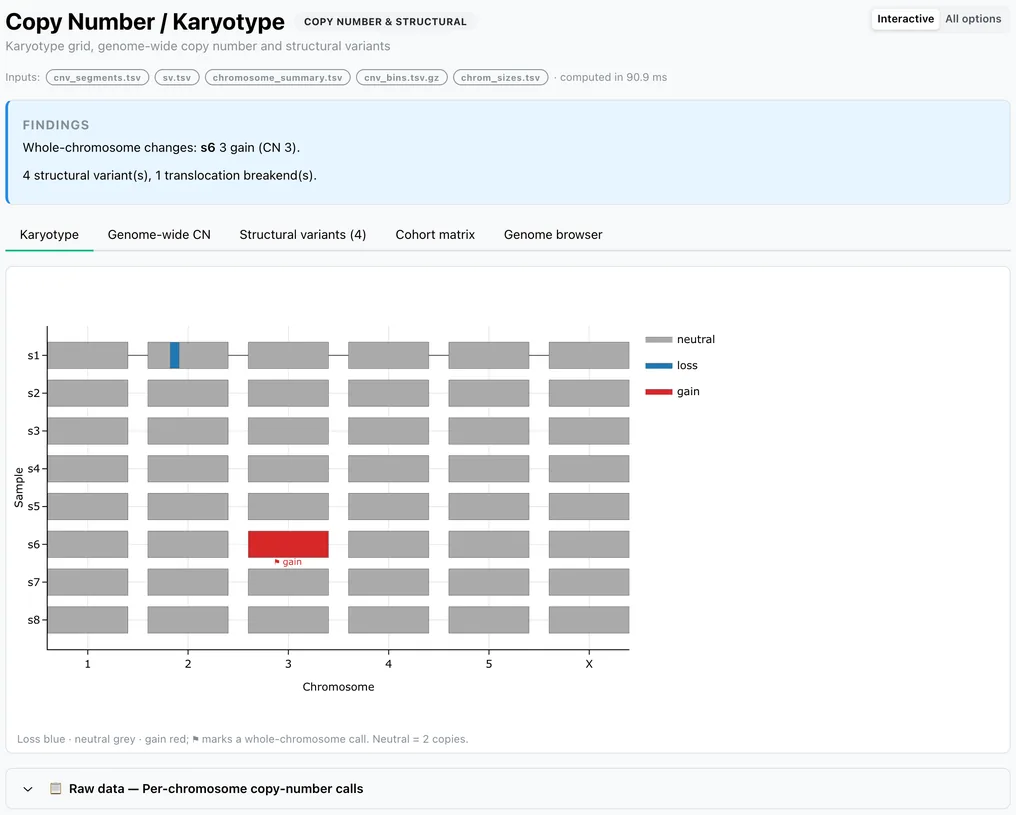
Example output from a demonstration project with synthetic data.
Under the title, Inputs: names the files read, among cnv_segments.tsv, sv.tsv, chromosome_summary.tsv, cnv_bins.tsv.gz and chrom_sizes.tsv.
Findings
- Whole-chromosome changes — each sample and chromosome called as a gain or loss, with its copy number (for example "s6 3 gain (CN 3)"), or "No chromosome departs from N copies", where N is the project's ploidy.
- Structural variants — how many structural variants were called and how many of them are translocation breakends.
Views
The report is organised in tabs. Each appears only when its data exists.
Karyotype
A grid with one row per sample and one column per chromosome. Each chromosome is drawn as a box coloured by copy-number state — loss blue, neutral grey, gain red — with segments that differ from the rest of the chromosome shown within the box. ⚑ marks a whole-chromosome call. A caption gives the neutral copy number (for example Neutral = 2 copies).
Genome-wide CN
The copy-number profile of one sample along the whole genome: bins as points and segments as lines on a log2 ratio axis, chromosome after chromosome. Segments are coloured as gain or loss when their log2 ratio is above 0.2 or below −0.2. A Sample selector appears above the tabs while this view is open.
Structural variants (N)
A table of the structural variants, with the count in the tab name. Columns include sample, chrom, start, end, svtype (DEL, DUP, INV, INS, BND), and, when delivered, id, svlen, filter, qual, chrom2 and pos2, plus breakpoints — a readable position such as chr2:5,000,001–7,000,000, or chr1:8,000,000 ↔ chr4:3,000,000 for a translocation.
Cohort matrix
A heatmap of copy number per sample (rows) and chromosome (columns), with the value in each cell (CN). The colour scale is centred on the ploidy, so gains and losses stand out across the whole cohort.
Genome browser
An embedded genome browser showing the copy-number segments and structural variants, for zooming into a region. Shown when chromosome sizes and segments or structural variants are available.
Raw data
Raw data — Per-chromosome copy-number calls
Shown when there are whole-chromosome calls.
| Column | Meaning |
|---|---|
sample |
Sample |
chrom |
Chromosome |
copy_number |
Estimated copy number |
state |
gain or loss |
flag |
The whole-chromosome call |
Interactive / All options
Interactive (the default) is the tabbed view described above. All options shows the full report on one page, which adds:
- Sample for the genome-wide plot — the sample selector for the genome-wide profile; when no bin-level data exists, the pipeline's own CNVkit scatter image is shown if delivered;
- a Cohort copy number heatmap and raw-data table;
- filters on the structural-variant table: Type, Min length (bp) (translocation breakends are never hidden by it), PASS only and Samples. These narrow that table only.
In All options the charts follow the Appearance settings in the Report settings panel (see Report Settings).
Reading it
- A whole chromosome in red or blue in one sample is an aneuploidy (for example trisomy for a gain to 3 copies in a diploid). A smaller coloured block inside a chromosome is a segmental gain or loss.
- On the log2 ratio scale, 0 is the neutral copy number; in a diploid, one extra copy is about +0.58 and one lost copy −1. Mixed or mosaic samples give smaller shifts.
- Translocation breakends (
BND) join two chromosomes; check both positions in the breakpoints column. - Low heterozygosity across a chromosome in Chromosome Variant Density supports a loss or copy-neutral loss of heterozygosity on that chromosome.