
RNA Sequencing
Why RNA-seq
Why analyze RNA?
RNA reveals the dynamic activity of genes — what’s turned on, when, and where. By studying RNA, researchers gain insight into how cells function, adapt, and respond to their environment. RNA sequencing quantifies gene expression across conditions.
Assess cellular state & function
DNA holds the blueprint, but RNA shows which genes are actively shaping cell behavior — reflecting how cells respond to stress, differentiate, or transition between states.
Example: In drought-stressed rice, elevated expression of ABA-related genes like RD29 and NCED signals activation of stress-response pathways.
Uncover gene function & pathways
Tracking when and where genes are expressed helps decode their roles in biological processes.
Example: During pathogen attack, plants upregulate defense genes like WRKY33 and PAD3, revealing key players in immunity.
Enable diagnostics & biomarker discovery
Certain RNA transcripts are uniquely expressed in disease states and can serve as diagnostic markers or therapeutic targets.
Example: Overexpression of HER2 mRNA identifies specific subtypes of breast cancer, guiding treatment decisions.
Discover novel transcripts & isoforms
RNA-seq uncovers previously unknown genes, alternative splicing events, and non-coding RNAs (e.g., lncRNAs, miRNAs), expanding our view of genome complexity and regulation.
The workflow
RNA-seq, from sample to insight
A standard differential-expression workflow — the same pipeline Liragen automates end to end, whether you start from your own RNA or a public NCBI dataset.
-
1
Sample & library prep
RNA extraction, quality control, and library construction ready for sequencing.
-
2
Sequencing
High-throughput NGS reads — or start directly from public SRA / NCBI accessions.
-
3
QC & alignment
Read quality control, adapter trimming, and alignment to the reference genome.
-
4
Quantification
Counting reads per gene and normalizing expression across all samples.
-
5
Differential expression
DESeq2 identifies genes significantly up- or down-regulated between your contrasts.
-
6
Enrichment & interpretation
GO/KEGG enrichment, networks, and plain-language interpretation of what the results mean.
RNA-seq with Liragen
Turnkey RNA-seq analysis — no code required
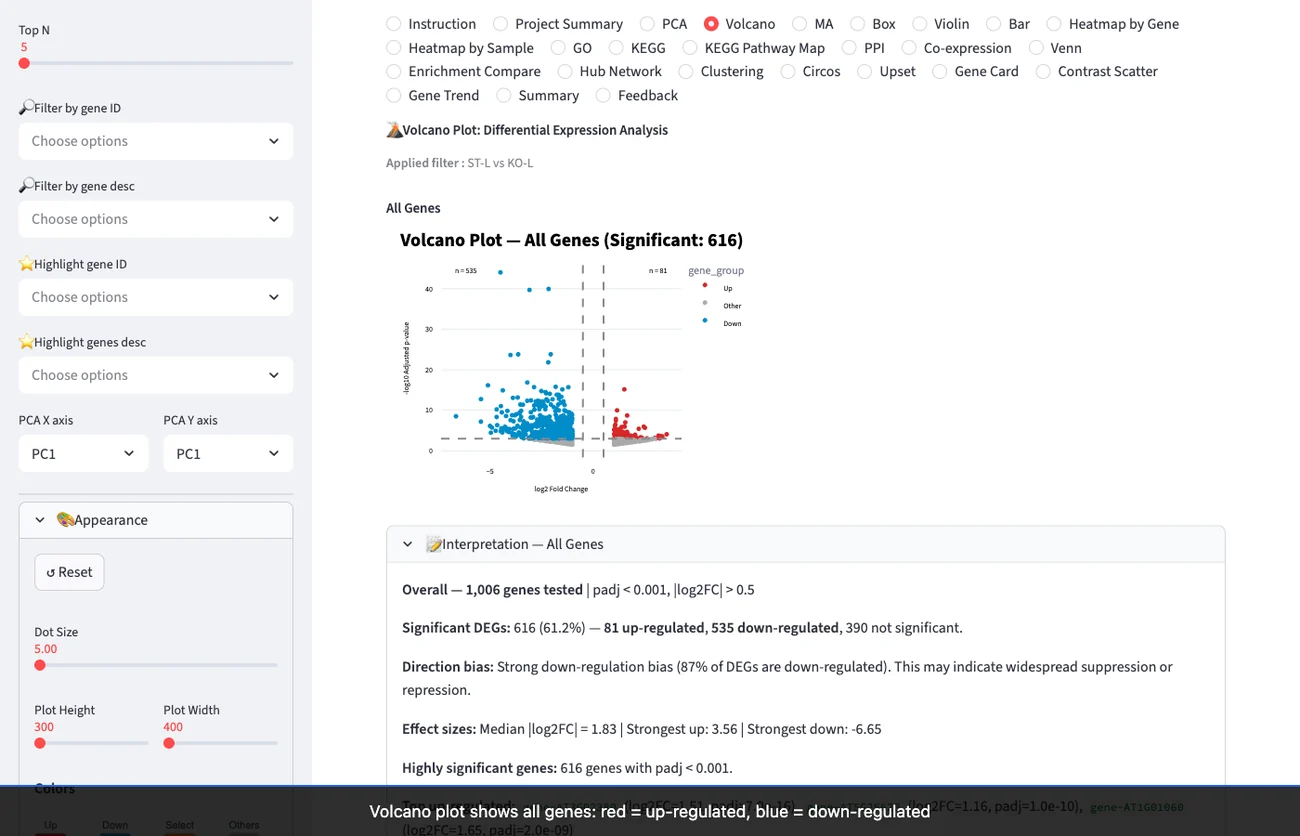
Liragen runs the whole differential-expression pipeline for you and delivers it as interactive, self-explaining reports. Start from your own raw data or an NCBI accession ID, then explore the results right in your browser.
- Automated DESeq2 differential expression + GO/KEGG enrichment
- 29 interactive reports — Volcano, PCA, heatmaps, pathways, networks
- AI-written interpretation on every report, updated as you filter
- Nothing to install — point-and-click in the browser